Europe
Europe: A Journey Through History, Culture, and Diverse Landscapes
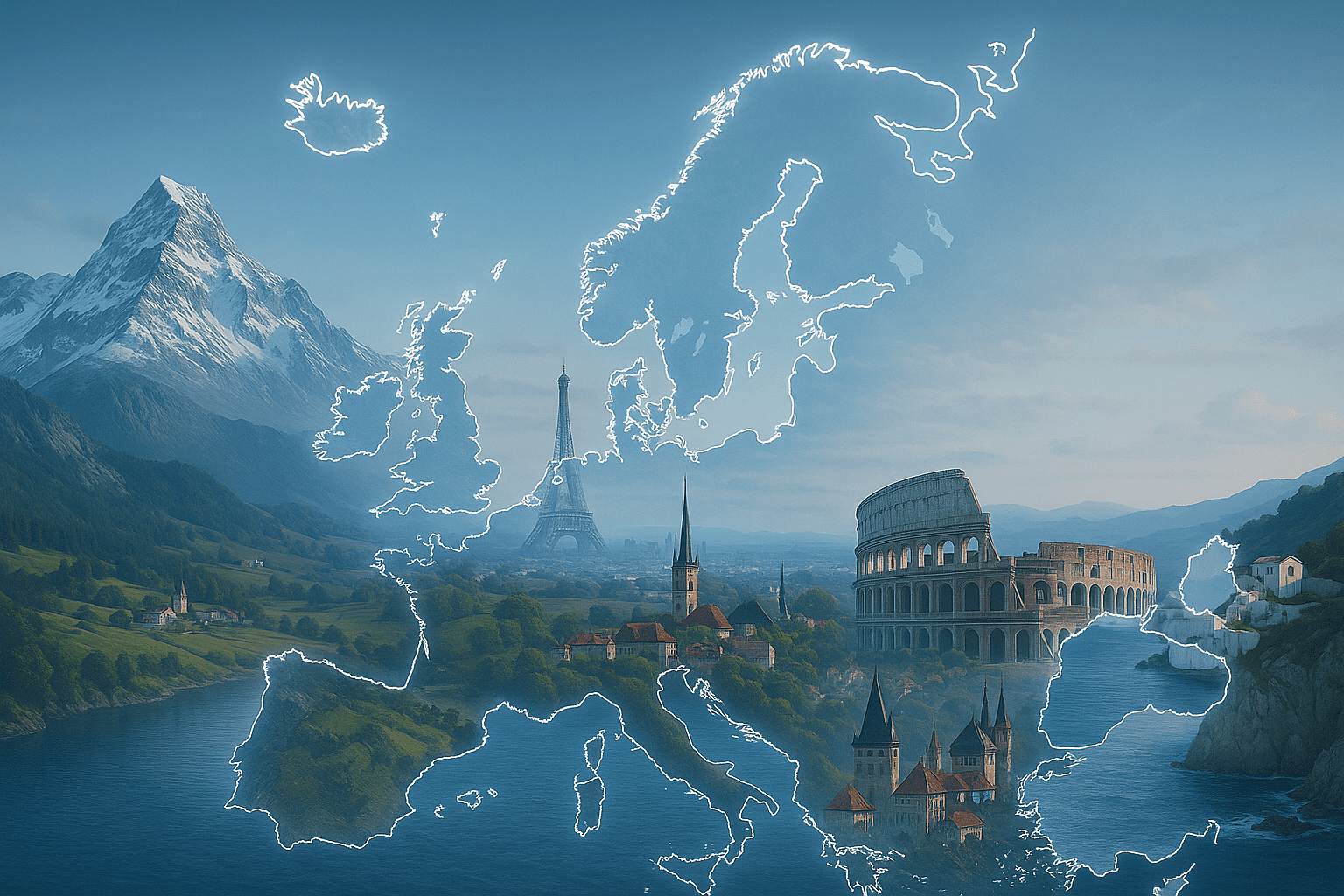
Europe, often called the “Old Continent,” forms the westernmost peninsula of the supercontinent Eurasia. Geographically, it is bordered by the Arctic Ocean to the north, the Atlantic Ocean to the west, and the Mediterranean and Black Seas to the south. Its conventional eastern boundary is defined by the Ural Mountains, the Ural River, and the Caspian Sea.
Despite being the second-smallest continent by area—covering approximately 10.18 million square kilometers—it is home to around 745 million people across roughly 50 sovereign states. Europe holds profound historical significance as the birthplace of Western civilization, beginning with Ancient Greece and the Roman Empire. This legacy continued through the Middle Ages, the Renaissance, the Age of Discovery, and the Industrial Revolution, shaping the modern world in fundamental ways. Its dense network of nations and cultures makes it a complex and influential global hub
Population and Societies image
Europe ranks third in population among the continents and is known for its high density, especially in Western and Central areas such as the Rhine-Ruhr Valley, the Po Valley, and the metropolitan regions of London, Paris, and Berlin. Culturally, it is a kaleidoscope of languages, traditions, and ethnicities. Hundreds of languages — mainly from the Romance, Germanic, and Slavic families — coexist. Modern migration has further enriched its cities, creating multicultural hubs like Brussels, Barcelona, and Stockholm. Most Europeans enjoy high living standards and urban lifestyles, making the continent one of the world’s most developed and cosmopolitan.
Geography and Ecosystems
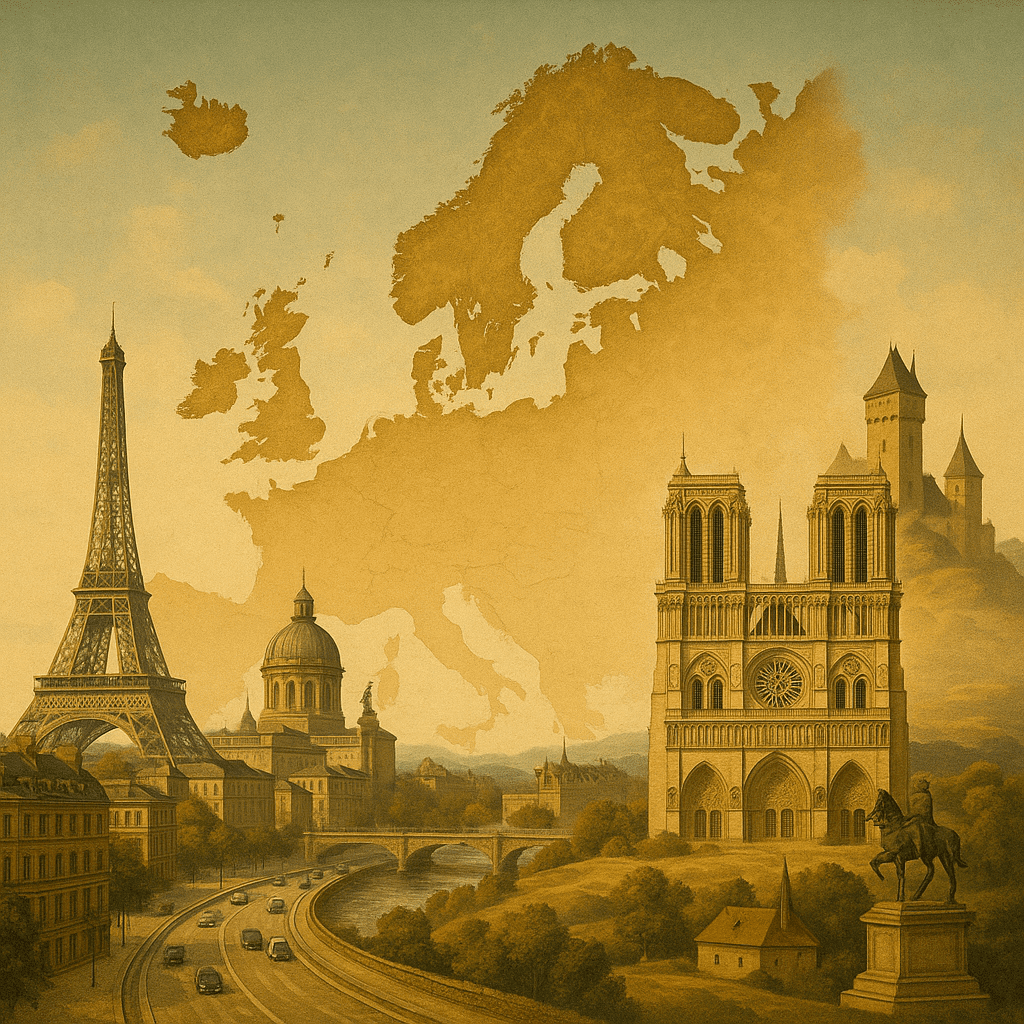
Europe’s geography is remarkably varied despite its relatively small size. The continent is defined by its long, indented coastline and its major peninsulas—Scandinavia in the north and the Iberian, Italian, and Balkan peninsulas in the south.
The landscape is dominated by the Great European Plain, which stretches from France to the Ural Mountains. Major mountain ranges act as both physical and climatic barriers, including the Alps, which peak at Mont Blanc; the Pyrenees between Spain and France; the Carpathians in Eastern Europe; and the Caucasus Mountains at the border with Asia, home to the continent’s highest peak, Mount Elbrus.
Europe’s hydrology is rich, featuring major rivers such as the Danube, which flows through ten countries; the Rhine in the west; and the Volga, its longest river, in the east. Vast boreal forests, or taiga, cover much of Scandinavia and northern Russia, while temperate forests dominate further south. The Mediterranean basin offers a distinct semi-arid climate, contrasting sharply with the Arctic tundra of the far north.
Wildlife includes protected populations of brown bears, wolves, and lynx, while the coastlines support an array of diverse marine life
Cultural and Historical Diversity
Europe’s cultural identity is a tapestry woven from millennia of history. It is the cradle of foundational civilizations such as Ancient Greece and the Roman Empire, whose philosophy, law, and art continue to resonate today.
The continent is linguistically diverse, with over 200 languages spoken, though most belong to the Romance (French, Spanish, Italian), Germanic (English, German), and Slavic (Russian, Polish) families. Religiously, Europe remains predominantly Christian—encompassing Catholic, Protestant, and Orthodox traditions—but it also holds deep-rooted Jewish heritage and significant Muslim populations, particularly in the Balkans and Western Europe.
This layered history is visible in its architecture, from Gothic cathedrals and Renaissance palaces to the avant-garde movements of the 19th and 20th centuries, including Impressionism and Cubism, both born in Europe
Traditional Cuisine
European cuisine is deeply regional and reflects both geography and culture.
The Mediterranean style, prominent in Italy, Greece, and Spain, emphasizes olive oil, fresh vegetables, pasta, wine, and seafood. Central and Eastern Europe, including countries such as Germany, Poland, and Hungary, features heartier dishes that often rely on potatoes, cabbage, pork (especially sausages), and rich sauces. French cuisine is celebrated for its refined techniques, cheeses, and pastries, while the Nordic countries rely heavily on fish—particularly preserved salmon and herring—along with dairy products and dark rye breads.
This culinary diversity reflects Europe’s range of climates, agricultural practices, and cultural traditions.
Economic Features
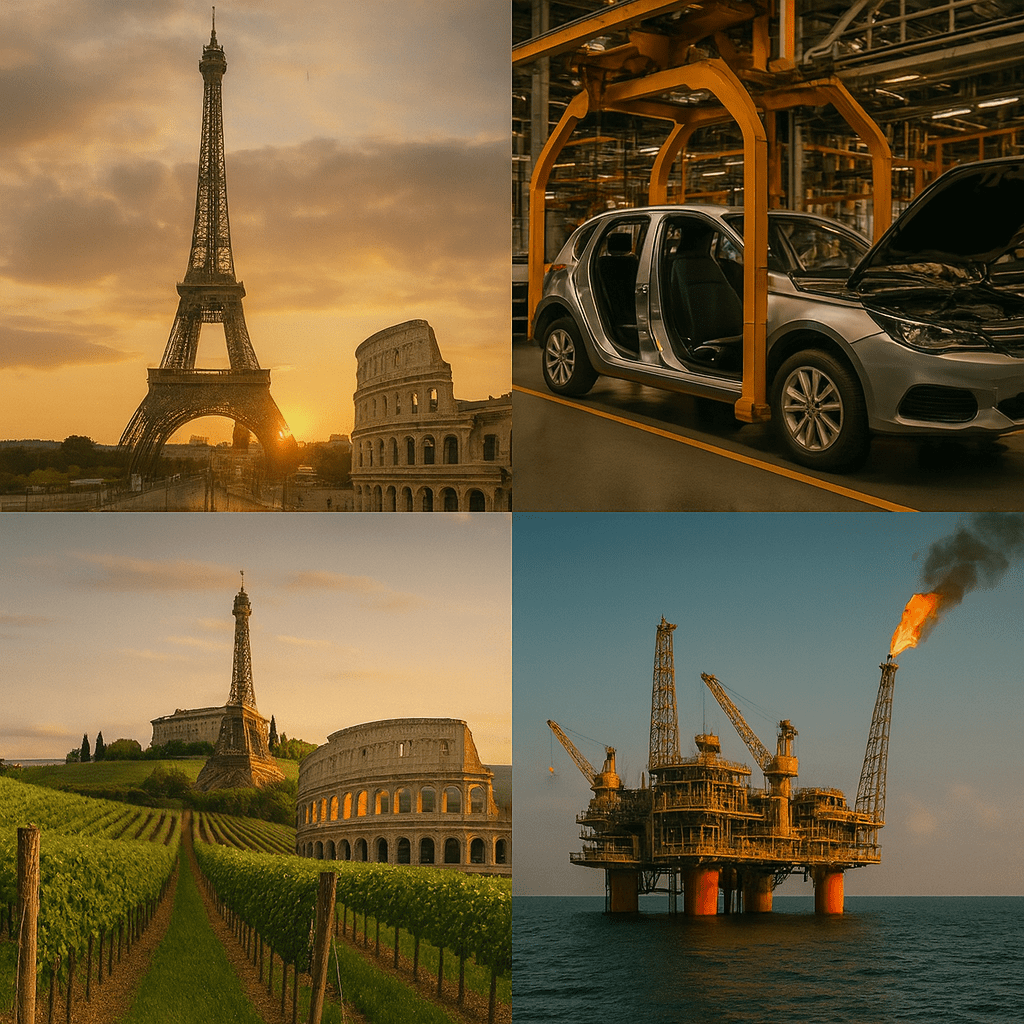
Europe possesses one of the world’s largest and most advanced economies. The European Union (EU) forms a vast single market, facilitating trade among its 27 member states and utilizing a common currency—the Euro—in 20 of them. The continent is a global leader in manufacturing, particularly in the automotive industry (Germany), aerospace, pharmaceuticals, and chemicals. Its agricultural sector is highly efficient and heavily subsidized, producing large quantities of wheat, wine, olives, and dairy products. Tourism is a crucial economic driver, especially for Mediterranean nations such as France, Spain, and Italy. Although Europe relies heavily on imported energy, the North Sea (bordering the UK and Norway) provides significant oil and gas reserves
UNESCO World Heritage Sites
Europe is densely packed with sites of “outstanding universal value,” boasting over 500 UNESCO World Heritage Sites across its nations. This extraordinary concentration reflects its deep and well-preserved history.
Among the most iconic examples are the Acropolis of Athens in Greece, the Historic Centre of Rome and the Colosseum in Italy, the Banks of the Seine in Paris (including the Eiffel Tower and Notre Dame), and Stonehenge in the United Kingdom.
Quick Facts
Number of Countries: ~50
Total Population: ~745 million
Longest River: Volga River (3,692 km)
Highest Mountain: Mount Elbrus (5,642 m)
UNESCO World Heritage Sites: Over 500
Annual International Tourists (Pre-pandemic): Over 700 million